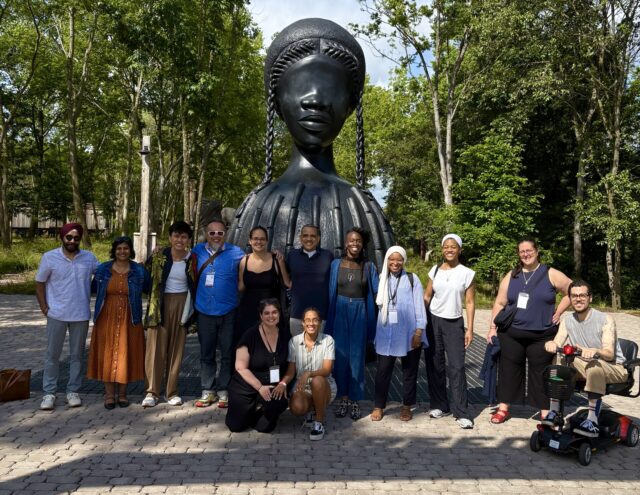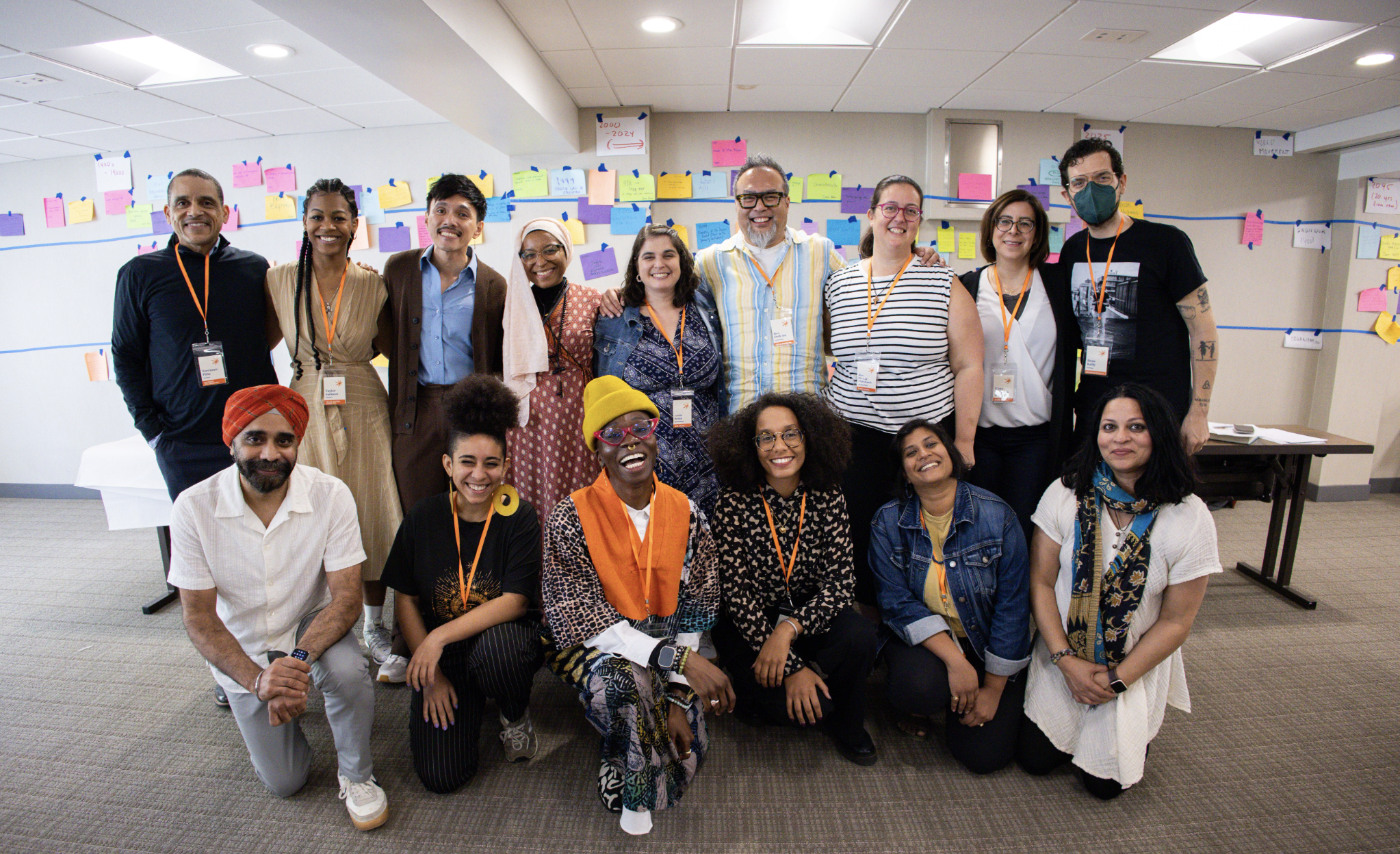

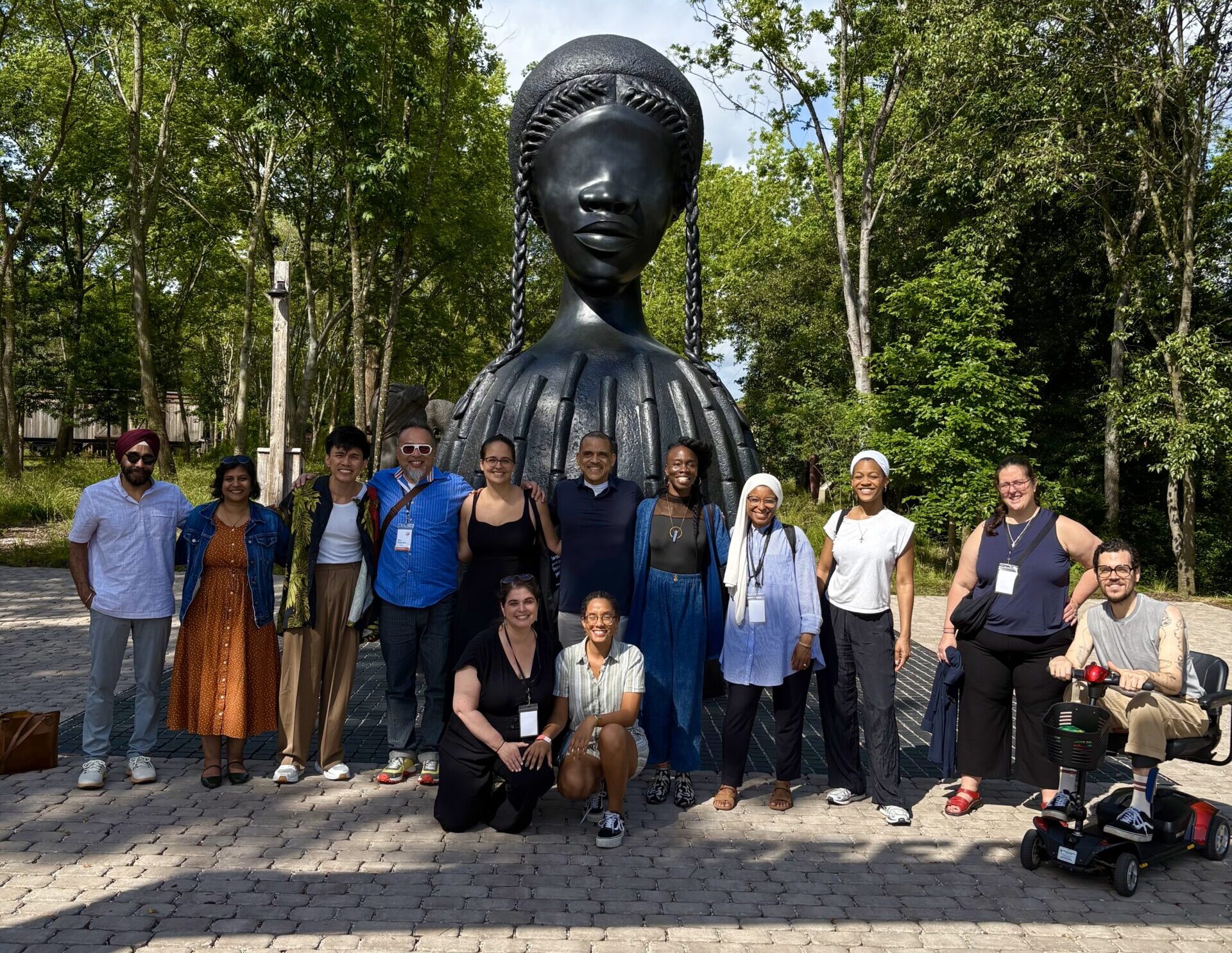
This past May, the Solidarity Collaborative organized a convening for its inaugural cohort of racial and social justice leaders at the Legacy Sites in Montgomery, Alabama to gather in community and reflect on our country’s legacy of racialized violence and resistance. Solidarity Collaborative Director Terrance Pitts reflects on the experience.
We visited the Legacy Museum, National Memorial for Peace and Justice, and Freedom Monument Sculpture Park. Not far from the National Memorial, we also met with artist Michelle Browder on the More Up Campus to take in the Mothers of Gynecology Monument – a set of sculptures of three enslaved women (Anarcha, Betsy, and Lucy) who suffered experimental gynecological surgery by Dr. J. Marion Sims.
Each of the Legacy Sites offers a compelling yet distinct narrative of the racialized violence and white supremacy that has been a defining and unfortunate feature of our country’s history that persists today. At the National Memorial for Peace and Justice, I shuddered at the sheer brutality of lynching violence, the indescribable and unimaginable torture suffered by the lynching victims, and legacy of trauma experienced by surviving family members. At the Legacy Museum, I was reminded of the brutal and profit-driven nature of the slave trade – unceasing in the commerce of Black bodies. As I watched the accumulation of small black dots representing slave ships speed up and move across the Atlantic Ocean at a dizzying pace over time on an animated map of the Trans-Atlantic Slave Trade, I understood more than ever before how the heartless, dehumanization of Black bodies has been inextricably tied to our country’s wealth accumulation.
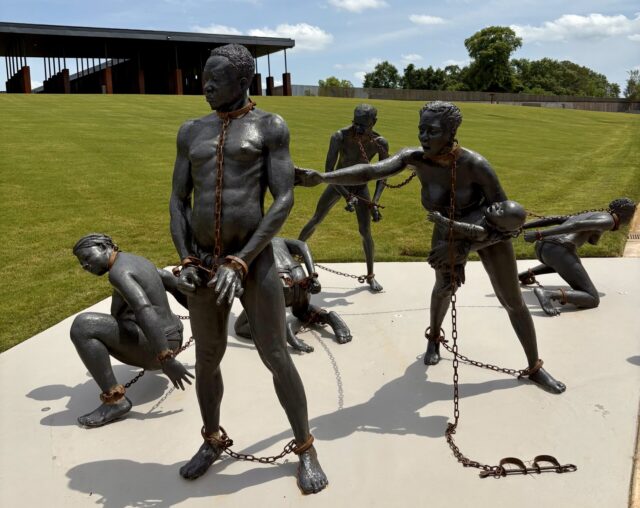
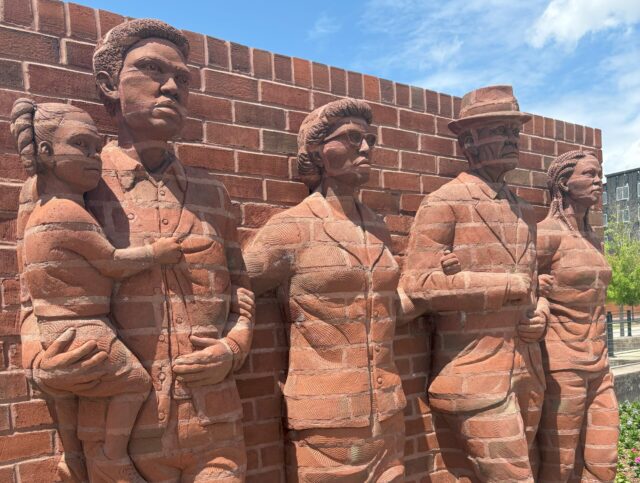
Yet, at the Legacy Museum, I was also reminded of the power of resistance and solidarity told through the stories of brave souls like the Freedom Riders and participants in the Montgomery Bus Boycott. At the Freedom Monument Sculpture Park, I marveled at the beautifully curated and crafted use of art, multi-media, and large-format sculptures to tell stories of bravery, survival, resistance, and hard-fought struggle for freedom and justice. I was in awe at the mastery of artists who poured their creative genius into powerful works that have deep emotional resonance and impact.
We were fortunate enough to have time and space to debrief these highly emotional visits with facilitators from the Radical Optimist Collective. They allowed each of us to make connections between our country’s history of racialized violence, the manifestations of authoritarianism we are seeing today rooted in nativism and white supremacy, and the necessity of creating spaces of solidarity as bold acts of resistance. Relatedly, I was inspired by our discussions with Alabama racial and social leaders, including Deanna Fowler (Alabama Forward), Pres Harris (Alabama Arise), and Allison Hamilton (Alabama Coalition for Immigrant Justice). In their work, I heard that solidarity is a necessary part of today’s resistance movements.
What became clear during our visit was the need to continue to invest in solidarity-based advocacy and organizing to advance racial justice and counter rising authoritarianism. Solidarity-based advocacy differs fundamentally from many traditional models of organizing and philanthropic giving that may focus on short-term policy wins. Solidarity demands deep, long-term investment – relationally and structurally – in the leadership of those most impacted by injustice. Solidarity-based advocacy is grounded in a transformative agenda of collective liberation – a practice rooted in the belief that systems of oppression are interconnected—and so is our freedom. These practices of transformative solidarity – seeing our struggles connected to others, aligning forces, and supporting communities that may be different from our own – are the foundation of a pluralistic and multi-racial democracy.